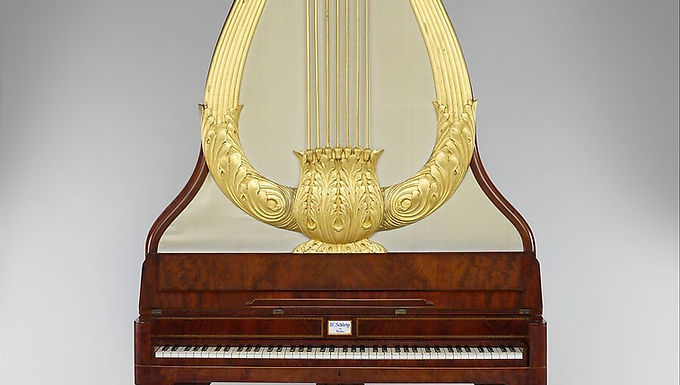
Lyre Piano by Schleib, J
Maker:
Schleip, J
Number of manuals:
one
Year:
1820-1844
Museum:
The Metropolitan Museum of Art
Date Range
1800-1850
Current Location:
North America
Material:
Wood, Gilt, Ivory
Painter:
Pedals:
Three
Catalogue Number:
CEP-3152
Origin:
Germany
Type:
Lyre Piano
From about 1825 on, Schleip built it, as here, with pedals. Finally, in about 1832 he began building heavier instruments with hanging actions. Its three pedals are for una corda, bassoon effect, and release of the dampers. A technical particularity of the instrument is that the sound board is suspended only on the right side so that its left side can vibrate freely like a tuning fork. To balance the volume between bass and treble and to prevent the bass from becoming too dull, the bass side of the sound board is spared. Finally, to further the harmony and beauty of the sound, the strings, the grain of the sound board, and the beams of the supporting structure run parallel to each other at the same angle.
Technical description: Compass. CC to a(superscript 4) (six octaves and a sixth). Three pedals (from left) una corda, bassoon (to g²), damper; lower case of mahogany or jacaranda veneer on four wooden legs terminating in metal claw feet; upper case in shape of gilded seven-string lyre, decorated with carved foliage on cross-bar and body, fluted arms terminating in griffin's head at each end, silk front; keys, ivory naturals, ebony sharps, white name-plate in center of nameboard bordered by marquetry lozenge band, repeated on sides of keyboard. Credit: Met Museum