List of Keyboards


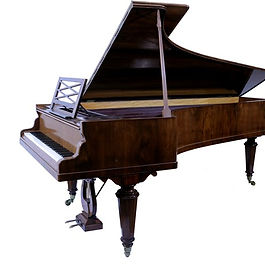
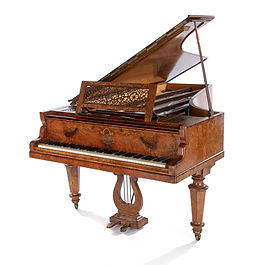
Grand Piano by Erard
From the 2nd half of the 18th century, the Conservatoire National Supérieur de Musique de Paris had almost exclusively Erard grand pianos at its disposal. This meant that Parisian composers, pianists and musicians grew up almost exclusively with the sound of Erard pianos for about forty tears. Erard was succesfull in many other countries as well.
Technical data:
Inscription: ERARD
Compass: 7 octaves (AAA-a'''')
Keyboard: naturals in ivory, sharps in ebony
Pedals: 2: controlling keyboard shift - dampers
Dimensions: L 248 cm / W 143 cm
Serial number: 38273
Chris Maene Collection number: CM 43 292
Condition: restored to concert level Chris Maene workshop Ruiselede 2012
Location: 3 - Museum headquarters "Piano's Maene" Ruiselede
Chris Maene Collec
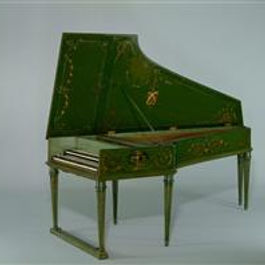

Pedal Piano by Erard
The Érard pedal piano owned by Charles-Valentin Alkan is one of the most remarkable surviving keyboard instruments of the nineteenth century. Built by the Érard firm in 1853, it is now preserved at the Musée de la Musique. The instrument was designed to bridge the worlds of the piano and organ, allowing pianists and organists to perform complex pedal parts without needing access to an organ. It became closely associated with Alkan, who composed some of the most demanding and imaginative works ever written for the pedal piano, including his Études pour le piano-pédalier and Onze Grands Préludes.
Unlike an ordinary grand piano, Alkan's Érard incorporates a full pedalboard beneath the keyboard. The pedals are not simply sustain or soft pedals; instead, they form a second keyboard played with the feet, operating a separate bass mechanism. The 1853 Érard model has a three-and-a-half-octave pedalboard, extending the instrument's range and making it possible to perform organ repertoire and highly independent bass lines. It also features Érard's famous double-escapement action, giving the manual keyboard the rapid repetition for which the firm was renowned
Photo Credit: Louislegrand14 Wikicommons
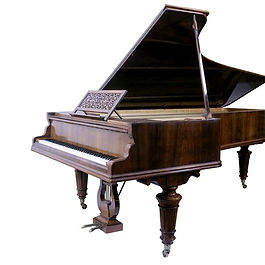
Grand Piano by Erard
From the fourth quarter of the 19th century, just about all piano builders adopted the cross-string system invented by Steinway & Sons in 1859-1860. Only Erard in Paris and Broadwood in London stayed true to the straight strung concept.
Erard went on the offensive with this type "Nouveau modèle, extra-grand de concert" with a length of 260 cm and a keyboard of 90 keys.
Technical data:
Inscription: ERARD
Compass: 7,5 octaves (GGG-c''''')
Keyboard: naturals in ivory, sharps in ebony
Pedals: 2: controlling keyboard shift - dampers
Dimensions: L 260 cm / W 155 cm
Serial number: 78473
Chris Maene Collection number: CM 43 254
Condition: restored to concert level Chris Maene workshop Ruiselede 2016
Location: 3 - Museum headquarters "Piano's Maene" Ruiselede