List of Keyboards

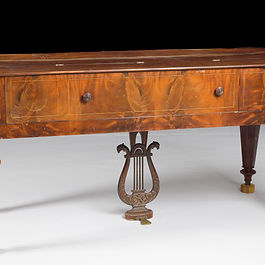
Square Piano by Albrecht, C
This square piano was made by Charles Albrecht in Philadelphia, Pennsylvania around 1797-1799. Albrecht born in Germany, was in Philadelphia by 1788 and was active there in the 1790s. Some of his instruments are among the earliest surviving American pianos. This piano is serial number 21 and has a compass of FF-f3, a single (Zumpe) action, double-strings, with tuning pins to the right, there is evidence of one stop to raise dampers, wood frame, and a mahogany (?) case
Credit: Smithsonian
Clavichord
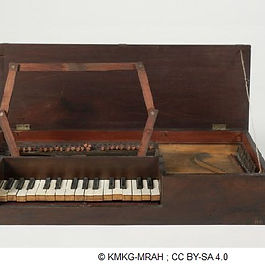
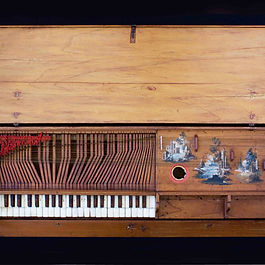
Compass: C/E–a². Fretting starts at: e.
e-f-f#|g-g#-a|b♭-b-c¹-c#¹|d¹-e♭¹-e¹|f¹-f#¹-g¹-g#¹|a¹-b♭¹-b¹| thence uncertain.
Two bridges arranged at right angles to the case and two ‘hold-downs’ attached to the soundboard. Compartments with lids to left and right of the keyboard. The cranking of the keylevers is reminiscent of the Neapolitan clavichord in the Leipzig museum
Anonymous, Peru, possibly 1600s. Quito, Ecuador, Pedro Traversari Collection, No. 4137
Sources: Richard Rephann, Catalogue, also personal communication
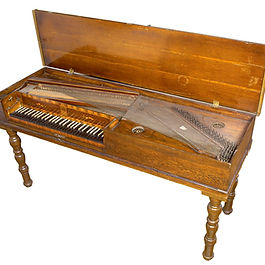
Clavichord
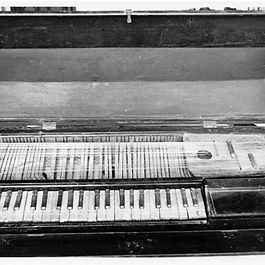
We do not know much about this exhibit. It is a typical clavichord which – as a separate musical instrument – appeared in the 14th century. The use of clavichords spread in the 1st half of the 16th century. The one from the collection of the Museum of Ziemia Biecka came from the 18th century, from the time when the clavichord reached its final shape; among other features, it was equipped with legs. In previous centuries it had a form of a small box which made it possible to carry an instrument. Along with the structural changes and improvement in the methods of producing the sound, the size of the instrument and its use were extended. It was used for practicing and soloing. For public performances a harpsichord was rather used as its sound was louder and the timbre was sharper.
Both Johann Sebastian Bach and his son Carl Philipp Emanuel Bach eagerly used the clavichord while the latter specialised in compositions played on this instrument