List of Keyboards


Harpsichord by Calisto, J
DescriptionThis wonderfully preserved instrument is typically Portuguese in both its design and decorative style. The single manual, with boxwood-covered naturals and ebony-covered sharps, has the common eighteenth-century Iberian five-octave compass of GG to g3 (61 notes). There are two registers at 8' pitch; the front register is permanently engaged, while the back register is controlled by a hand stop on the right side of the keyboard. A second hand stop on the left controls a buff stop affecting the front 8'.


Square Piano attr Caspar Katholnik (Katholnig)
This unsigned piano is attributed to the Viennese maker Caspar Kaholnik because of its similarities to an instrument by that maker located in the Hungarian National Museum in Budapest. Katholnik was born in Villach (Beljak), Carinthia, Austria, and moved to Vienna where he received a license to make instruments in 1801, becoming a citizen of the city a year later. In addition to square pianos, he advertised upright pianos, but none is known to survive. Credit: Met Museum


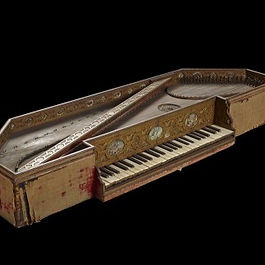
Virginal (Hexagonal) by Celestini, G
A highly decorated hexagonal Venetian virginal. The compass is C/E–f3, four and a half octaves with a short octave. The short octave is a way of extending the compass without adding accidentals which would not have been needed in bass lines at this time. Thus, while the lowest note appears to be E, it would have been tuned to C. Surviving instruments are highly decorated, demonstrating the importance of musical instruments as visual as well as oral objects and signifiers of culture, status and wealth. Here, the rose, fixed into the circular hole cut into the soundboard, is made up of 4 intricately cut layers of parchment which have been gilded. While many instruments of the period are designed to be housed in an outer case, this example is built simply to give that appearance, described as a ‘false inner-outer’. While it has been suggested that the present red velvet tacked onto the outside of the case is a 19th-century accretion, there is no doubt that the extremely fine lacquer work found on other parts of the case is original. Of a type known as lacca da Venezia, the decoration, painted onto cypress strapwork, draws inspiration from middle-Eastern techniques and designs. The three vignettes on the nameboard, painted onto mother-of-pearl lozenges, show three episodes from the life of Apollo, the Greek god of music: Apollo playing to the beasts; Apollo & Daphne; and Apollo & Pan
Credit: Royal College of Music