List of Keyboards

Grand Piano by Clementi
A relatively short grand piano with the standard English grand-piano action. Compass FF-f4 (6 octaves); ivory naturals with maple molding in front, ebony sharps; two pedals: una corda, dampers. Bichord stringing throughout; bridge and nut divided at F/F#. Iron hitch-pin plate (painted in gold color) with two iron struts to the wrest plank. There is one hitch pin for each pair of strings, i.e., the string loops around as in modern pianos; the holes in the wrest pins therefore original. Open-bottom construction. Visible exterior and interior surfaces of the case, lid, etc. veneered in rosewood; wrest plank and yoke veneered in maple. Front ends of spine and cheekpiece, around keyboard, S-curved. Egg-and-shaft molding near bottom edge of case exterior, all the way around. Three screw-on legs, turned with carved capitals; casters.
Also labeled Collard & Collard, late Clementi. From the Estate of Bunker Clark, donated by his widow.
This piano was probably substantially completed and provided with the “Clementi & Company” inscriptions just before Clementi’s death on 10 March 1832. Afterwards, before the piano left the factory, the paper label on the yoke was added with the new form of the company name, from which Clementi’s name was dropped, “Collard & Collard.”
In the inscription on the fallboard, Lee sc[ulpsit, i.e., “engraved (this)”] is the signature of the engraver of the plate, from which printing in size (varnish) was transferred to the board and sprinkled with gold-colored powder
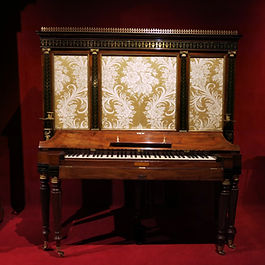


Upright Piano by Clementi
From 1800 onwards, the key compass never stopped expanding, resulting in keyboard instrumnets taking more place. William Southwell (London) acquired a patent in 1798 for a design where the square piano was put on its long side with the keyboard in front and an adapted action. Clementi & co also eperimented with this design and made this specific instrument around 1812. A second copy is at a museum in Stockholm.
Technical data:
Inscription: New Patent CLEMENTI & Co London
Compass: 6 octaves (FF-f'''')
Keyboard: naturals in ivory, sharps in ebony
Pedals: 1: operating dampers
Dimensions: W 144 cm / D 52 cm / H 151 cm
Serial number: 461 and 11236
Chris Maene Collection number: CM 35 328
Location: 2 - Museum "Chris Maene Collection" Ruiselede

Cabinet Piano by Clementi & Co
A very rare grand piano build in heigth with a bookcase inside. The curved fallboard is painted with Turk's cap lilies, primulas, sweet peas, roses and auricula.
The tuning pins are atached at the front above the keyboard, the action is at the back.
Technical data:
Inscription: Clementi & Co, Cheapside, Londen
Compass: 5,5 octaves (FF-c'''')
Keyboard: naturals in ivory, sharps in ebony
Dimensions: W 109 cm / D 57 cm / H 257 cm
Case: mahogany case with a moulded plinth and curved fall board
Serial number: 830 and 8144
Literature: "The Colt Clavier Collection Golden Jubilee 1944*1981", p. 31 (112) U420C.
"Early Piano", C.F. Colt with A. Miall, p. 60Chris Maene Collection number: CM 35 325
Location: 2 - Museum "Chris Maene Collection" Ruiselede

Square Piano by Clementi & Co
An English square piano in a mahogany case from the mid 1820s. Compass: FF to c4, 68 notes. English square ‘double action’. The action consists of three principal moving parts: an adjustable and sprung ‘hopper’ fixed to and raised by the key, an intermediate lever and the hammer itself. The hopper and lever are hinged with parchment and the hammer with leather.
Credit: Royal College of Music

Cabinet Piano by Clementi & Co
John Koster notes that this piano is probably earlier than the Clementi at the Boston MFA. The NMM’s instrument has 4, not 5, struts over the gap; MFA soundboard at angle to spine. FF to f4 compass was probably made ca. 1818 at the earliest.
Compass: FF-f4 (6 octaves)
Two pedals: left: una corda; right: dampers
Construction:
The case is veneered in mahogany with ebony stringing. Keywell veneered in satinwood (?) with ebony stringing. The nameboard contains a gold-painted arabesque chain with medallion in the center, which contains the maker's signature in ink. French polish finish (later). Left side 29.5 mm thick, right side 26.5 mm thick, bentside 27 mm thick. There are four iron gap spacers between c#/d, d1/d#1, d#2/e2, and d3/d#3. Rectangular, unpierced tuning pins. The soundboard grain runs parallel to the spine. There are two squared bridges made of beech: bass bridge FF-G#, treble bridge A-f4, cut to its curve. The outside ends of both bridges are cut square; the inside ends taper. Both bridges have deep notches and are double pinned throughout. The long bridge is 21 mm high and 16 mm thick. The nut is single pinned and divided at G#/A. The piano has two book shelves and two extendable candle shelves.

Cabinet Piano by Clementi & Co
This upright grand piano is a grand piano with the strings, soundboard and frame assembly rotated up to the vertical. The strings are of similar length and the tone could be as good as that of a horizontal grand.
Technical data:
Inscription: Clementi & Co, Cheapside, London
Compass: 5,5 octaves (FF-c'''')
Keyboard: naturals in ivory, sharps in ebony
Pedals: 2: keyboard shift - controling dampers
Dimensions: W 110 cm / D 58 cm / H 254 cm
Case: mahogany case inlaid with ebony lines and ormula decoration
Serial number: 866
Literature: "The Colt Clavier Collection Golden Jubilee 1944-1981", p. 31, (112) U420C
C.F. COLT & A. MIALL, "The Early Piano", ill. P. 62Chris Maene Collection number: CM 35 329
Location: 2 - Museum "Chris Maene Collection" Ruiselede
