List of Keyboards


Square Piano by Astor & Horwood
Crafted in London around 1820, this mahogany and satinwood piece is historically significant because it once belonged to the renowned Portuguese composer Alfredo Keil, who used it to compose the music for the Portuguese national anthem (A Portuguesa) in 1890
Credit: RickMorais Wikicommons

Square Piano by Astor, G
Technical description: Mahogany and mahogany veneer case with light and dark ladder-style striping, on table-stand with shelf between 4 tapered legs with gilt brass bolt covers at top of legs; compass FF-f3 (61 keys), ivory naturals with molded fronts, accidentals of ebony slips on darkened blocks; English single action without escapement, wood overhead damper arms extending from hinged panel in spine, lifted by thin wood rods; unpierced oblong tuning pins running diagonally across soundboard, double-strung throughout, 24 strings wound; 2 hand levers in well to left of keyboard, the upper (rear) raising dampers, the lower (front) raising padded wooden batten against strings in front of nut; 2 pedals, the right raising portion of lid for swell effect, the left operating front hand lever; nameboard painted with flowers flanking inscription; collapsible music stand, attached to back of nameboard; strings webbed with red felt behind bridge, the bridge deeply undercut (ca. 6 cm); lid stick on left side only; dust cover of green silk. Credit: Met Museum

Square Piano by Astor, G
This square piano was made by George Astor & Co. in London, England around 1799-1815. George Peter Astor had an apprenticeship in Germany and went to London about 1778. Astor also made flutes and had a music publishing business. This piano is serial number 3213 and has a compass of FF-c4, an English single action with escapement, double-strings throughout, the first 9 wound brass, the next 13 plain brass, and the rest iron, 1 pedal (attached to a leg): dampers, wood frame, and a mahogany case
Credit: Smithsonian

Square Piano by Astor, G
Compass: FF-f3; 61 keys
Astor moved to 79 Cornhill in 1797
Stops: buff (leather); damper
Construction:
The case is made of mahogany, with mahogany and fruitwood stringing. Corners are mitered dovetails. The bottom is 38 mm thick. There is one molding around the bottom of the case. The rectangular tuning pins are unpierced and are arranged in 29 rows of four, and three rows of two, with letters indicating note names. The tuning pins run though a wooden plate, 95 mm wide, 4 mm thick, atop the soundboard, which is let inot the molding surrounding the soundboard. The front of this plate has a squared wooden rail with leather on the top, which dampens the tuning pin segment of the string. The front left section of the soundboard is cantilevered over the top three key levers. It is braced on teh left side by a hardwood beam which rests on and extends over a brace left of the keyboard which is at least 80 mm thick and has two holes bored through it, diameter 25 mm, to increase the sound volume. The soundboard grain runs left to right. The one-piece bridge is rectangular and cantilevered in the bass and has a broad chamfer in the treble on the right side. It is single pinned throughout. There is one rib on the right side of the bridge, running roughly parallel to it. Another rib runs somewhat perpendicular to the bridge through the lower treble section. The case sits on a trestle stand with four squared legs. Each leg has a metal medallion with an emblem of musical instruments and a music book
Square Piano by Babcock, A
This square piano was made by Alpheus Babcock, for William Swift, in Philadelphia, Pennsylvania around 1833-1837. It is the only surviving Babcock from the period in which he worked as foreman at William Swift’s factory. Alpheus Babcock is best known for his invention of the one-piece metal frame for square pianos, patented December 17, 1825 in Boston. This piano is one of three known pianos with his patented iron frame. This piano is serial number 1517 and has a compass of FF-f4, Babcock patent action, leather top over layers of felt hammers (not original), double-strings, some wound, 2 pedals: moderator and dampers, Babcock’s patented one-piece cast iron frame, and a crotch mahogany veneered case
Credit: Smithsonian

Square Piano by Babcock, A
This square piano was made by Alphues Babcock for George D. Mackay in Boston, Massachusetts around 1822-1824. During the 1820s, Babcock was financed largely by the Mackay family. The inscription on the nameboard reads “Made by / A. BABCOCK / For / G.D. Mackay / BOSTON.” This piano is serial number 12/VI and has a compass of FF-c4, an English double action, basswood core leather hammers, double-strings throughout, 1 pedal: dampers, wood frame, and a mahogany veneered case with rosewood banding
Credit: Smithsonian

Square Piano by Babcock, A
Standard English square-piano double action.
One pedal: dampers.
Naturals covered in ivory; sharps ebony.
Bichord stringing; bass strings of Babcock’s usual type with iron cores with flat iron wrapping.
Case with rounded front corners, of mahogany with doubled lines of darker stringing near top and bottom; rosewood crossbanding at edge of bottom, at upper edge of which is a cast metal molding. Keywell veneered in rosewood with brass stringing. Nameboard with inlaid brass nameplate at center, surrounded by foliate decoration in gold with details in brown and white paint; lattice-covered rectangular openings near the ends. Fretwork panel over front portion of soundboard under lid flap; analogous panel to left of keyboard is missing. Faux-rosewood dust cover. Three drawers. Six turned reeded screw-on legs, with metal collars at top; matching pedal holder.

Square Piano by Babcock, A
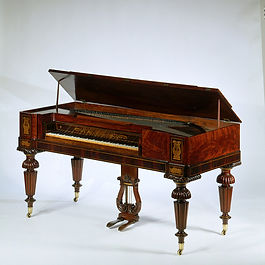
Technical description: Mahogany and mahogany veneer case resting on four cylindrical legs with bronze-gilt mountings at top and bottom, stretchers of square section on three sides, compass FF-f4 (73 keys), ivory naturals with molded fronts, ebony accidentals, lyre-shaped pedal lyre, 2 pedals, left lifting dampers, right lifting a mute from the portion of the strings to the right of the bridge; English double action with intermediate lever and escapement; crank over key lifts wire that passes through eyelet, supporting cloth-lined damper; double string throughout, bottom 14 notes wound. (Credit L. Libin 4 Aug 76

Square Piano by Babcock, A
Technical description: Rectangular case with rounded corners, mahogany striping surrounding the larger mahogany panels, nameboard veneered with rosewood, with fretwork panels and inlaid brass striping, wood dust cover painted green with black and gilded borders, turned and heavily reeded mahogany legs with brass caster, 5th leg supporting damper pedal; compass: FF-c4 (68 keys), ivory naturals with molded fronts, ebony accidentals; 1 damper pedal; oblong pierced and unpierced tuning pins along spine; English double action with intermediate lever and escapement with adjustment screw; crank-type dampers; double strung throughout lowest 14 notes wound with steel ribbon Credit: (L. Liibn 8 Dec 76)