List of Keyboards


Giraffe Piano by Raay, J and Sons
Giraffe piano by J. van Raay, Amsterdam, c.1825. Joannes van Raay was among the most important Dutch piano makers of the early nineteenth century. This elegant instrument, built in the Biedermeier style, features a finely crafted mahogany case with two removable front panels covered in dark green fabric.
Giraffe pianos are notable for their tall vertical form and often incorporate an unusually large number of pedals. This instrument is equipped with six pedals, controlling the following effects: mute, bassoon (bass section), dolce (bass section), dolce (entire keyboard), shift, and a janissary stop combining triangle and drum effects. These pedals provided performers with a wide range of tonal colours and orchestral imitations that were highly fashionable during the period. Photo Credit:Daderot Wikicommons

Harpsichord by Querci, P
This instrument was made by Pasquino Querci in Florence, Italy, in 1613. It is a single manual harpsichord with a compass of C/E - f3, and a disposition of 2 x 8’, with 2 wooden levers at the left side of the soundboard for moving slides. The soundboard is made of cypress and features a recessed rose made of gilt parchment. This harpsichord has ebony naturals and ivory topped accidentals. The nameboard, a later addition, is inscribed: “PASQUINO.QUERCI.FIORENTINO.FECIT.1613. IN CIJMBALIS.BENE.SONANTIBUS.LAUDATE” and "DOMINE.AD.SEMPER.AMEN.” (with resounding cymbals Sonata for all times Amen, Praise the Lord!)
The separable outer case is painted black with gold painted eagles and has panels of painted stylized floral designs around the sides. The top and sliding cover at the front of the keyboard are painted with bold floral designs in gold. The inside of the lid is painted with a landscape and figures. The stand is ornately carved and painted black and gold. Research indicates that the interior of the lid is painted in a Northern Italian style in the mid-17th century.
Other examples of Querci instruments are an octave spinet with a Querci inscription in the Metropolitan Museum of Art in New York, and a single manual harpsichord, previously attributed to Girolamo Zenti, in the Museum für Musikinstrumente der Universität Leipzig.
Credit: Smithsonian

Spinet by Querci, P
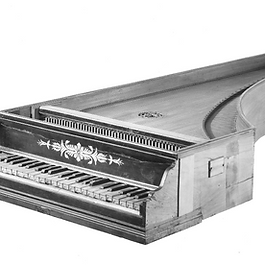
Technical description: Inner-outer case construction, inner case and soundboard are cypress, the outer case is covered with gilt-embossed leather, inside lid is painted with conventional ornaments; compass c/e-c4, d4, boxwood naturals with boxwood arcades, walnut accidentals, keyboard balance rail and back rail are glued to the bottom, no front rail, but padding is glued to bottom under key heads to control key dip; jacks are pear with beech tongues, brass leaf springs, slots for double flag dampers (none present), and leather plectra, box guide is built up of shaped blocks; multi-layered parchment rose. Credit (Douglas Maple, 1983)


Square Piano by Preston, J
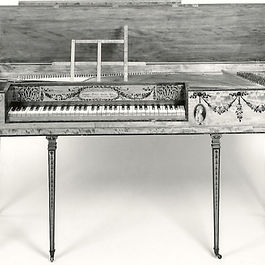
Technical description: Rectangular satinwood Hepplewhite case with narrow rosewood edging and ebony and holly striping painted outside with floral garlands and other elements including (on the sides) antique busts in beaded ovals and (on the lid) 2 beaded ovals flanking a central rectangular panel surmounted by griffons flanking an urn, the ovals and central panel depicting women and boys playing a variety of classical instruments, all painted somewhat in the style of Angelica Kauffmann: the case on 6 decorated square tapered legs on casters, the legs topped with carved Ionic capitals, with a 7th leg (missing) that held a damper pedal; composite nameboard with center section of 2 boards joined horizontally, with an inlaid oval on the lower board, the whole section flanked with clothbacked scrollwork panels, and the ends pieced out in a different wood, the nameboard not matching the veneers and inlay elsewhere on the case; a folding music rack behind the nameboard; English single action without back checks, the damper wires resting on short posts hinged to levers mounted on a rail over the keytails; compass FF-c4 (68 keys), ivory naturals with plain wood fronts, ebony-capped accidentals (except lowest of solid rosewood); top 10 keys extending below soundboard with hammers striking through a slit at rear of soundboard; top 10 notes undamped, lowest 10 notes with openwound strings, double strung throughout, tuning pins at right side; key frame and hinges altered and dust cover missing. Credit: Met Museum

