List of Keyboards

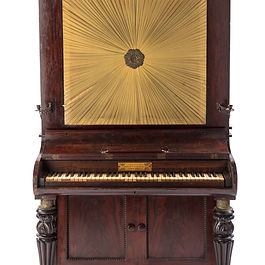
Upright Piano by Oehler, C
Compass: AAA-a4 (7 octaves) 85 notes
Two pedals: left: soft (half-blow); right: damper
Construction:
Case veneered in rosewood with ornately-carved legs, which have a rose on the top and heavily-carved lion's feet at the bottom.
The top panel has three frames; the center frame is oval with a panel containing multi-colored marquetry depicting a wood flute, an oboe, and panpipes, surrounded by a harvest scene of leaves and flowers.
There are ornate brass candle holders on both sides of the oval frame and handles on both sides of the piano.
The nut is in three pieces (two in the bass) and consists of a metal rod mounted to a wood rail.
A pressure bar extends through the entire compass of the piano.
There is a cast-iron hitchpin plate.
The bass bridge (AAA-c) is butted against and perpendicular to the treble bridge.
Both bridges are square and double pinned throughout.
The Soundboard grain is left to right
Stock Photo - This does not represent the piano

Square Piano by Nunns & Clark
This costly showpiece of Renaissance and Rococo Revival eclecticism, an obvious status symbol perhaps intended for display at New York's Crystal Palace exposition, elevated the reputation of the English immigrants Robert Nunns and John Clark, partners in New York since 1833; they had exhibited an equally ornate piano in London in 1851. Built on the scale of a billiard table, this massive rosewood instrument stands on elephantine legs surmounted by lush carved bouquets. Slips of mother-of-pearl, tortoiseshell, and abalone embellish the seven-octave keyboard. Within, a lacquered iron frame reinforces the case. The felt-covered hammers could have been made by machines invented by Rudolph Kreter, who assigned his patent to Nunns & Clark in 1853. At that time, some eighty employees, including members of the Steinway family, were producing about three hundred instruments annually at Nunns & Clark's factory in Setauket, Long Island. Credit: Met Museum
Square Piano by Nunns, R. Clark & Co
This square piano features a unique, exquisite birds-eye maple veneer, likely a custom order. The marbled cast iron hitch-pin plate with strut was a copy of Broadwood's 1823 design. Nunns is thought to be the first American piano maker to use a French square action on their instruments, a feature that later became ubiquitous, especially for New York-made pianos.
Compass: FF-f4 (six octaves)
Exterior and interior of case veneered in bird’s-eye maple, lid and flaps veneered en suite but with a wide ebony border inlaid with bird’s-eye maple in a foliate pattern; nameboard veneered in rosewood with inlay of bird’s-eye maple in a foliate pattern; four turned legs of striped maple, brass casters; black-painted cast-iron hitch-pin plate with faux marbling and oval openings, angled iron strut in treble
Pedals:
2 attached to lyre: moderator, dampers; moderator leathers individual
Action: French square action, lever overdampers (FF-d#3)
Keyboard:
Naturals: ivory, 45 mm, molded maple key fronts
Sharps: Ebony slips, 87 mm
Stock Photo - this does not represent the piano

Upright Piano by Nunns, R & W
This upright piano was made by Robert and William Nunns in New York, New York around 1832 (?) It is a short cabinet upright, about 61 inches high. Robert and his brother William emigrated from London to New York around 1821. Both worked for two years in the shop of Kearsing & Sons and two years later established the firm of Robert & William Nunns in 1823, manufacturing pianos both for themselves and for the company of Dubois & Stodart. This piano is serial number 502 and has a compass of FF-f4, tape-check action, leather hammers, double strings, 2 pedals: keyboard shift and dampers, wood frame, and a wood case with a silk paneled front
Credit: Smithsonian

Upright Piano by Nunns, R & W
This upright piano was made by Robert and William Nunns in New York, New York about 1831. It is a short cabinet upright, about 61 inches high. This piano is serial number 1444 and has a compass of FF-f4, an English sticker action, felt (?) hammers, double-strings, 2 pedals: keyboard shift and dampers, mahogany veneered case, and a silk front panel
Credit: Smithsonian
Cabinet Piano by Nunns, R & W
6 octaves, FF-f4 (72 notes)
Two pedals: damper and una corde.
Soundboard is picea (spruce). Back is tilia (basswood).
Front of case covered in yellow silk material, pleated, and centered with decorative floral/foliage medallion
Credit: National Music Museum, North America

Upright Piano by Nunns, R & W
This upright piano was made by Robert and William Nunns in New York, New York about 1830. It is a small cottage piano about 42 inches high. The metal frame would suggest that this piano was modernized at some time. This piano is serial number 1223 and has a compass of FF-f4, tape-check upright action, felt hammers, single-strings, some wound, 2 pedals: keyboard shift and dampers, metal frame, straight-strung, and a mahogany (veneer?) case
Credit: Smithsonian

Square Piano by Nunns, R & W
This square piano was made by Robert and William Nunns for Dubois & Stodart in New York, New York around 1824-1830. Robert and his Brother William established their firm in 1823, manufacturing pianos both for themselves and the company of Dubois & Stodart. This piano is serial number 543 and has a compass of FF-f4, and English Double action, leather hammers covered with felt, double-strings, the first 10 notes are wound, tuning pins at the rear, 1 pedal: dampers, an iron hitch-pin plate frame, and a mahogany case
Credit: Smithsonian

Square Piano by Nunns, R
This square piano was made by Robert and William Nunns for Dubois & Stodart in New York, New York about 1830. Robert Nunns and his brother William emigrated from London to New York about 1821, and both worked for two years in the shop of Kearsing & Sons. They established the firm of Robert & William Nunns in 1823, manufacturing pianos both for themselves and for the company of Dubois & Stodart. This piano is serial number 613 and has a compass of FF-f4, an English double action, double-strings throughout, first 10 wound, with tuning pins in rear, 1 pedal: dampers, an iron hitch-pin plate frame, and a mahogany case
Credit: Smithsonian
