List of Keyboards

Square Piano by Meijer
Meyer’s square pianos evidence English influence in their exterior and three of the four pedals: pizzicato, forte, and crescendo. The round legs and the fourth pedal – a moderator that inserts leather tabs between the hammers and the string – are typically French. The Meyer brothers flourished in Amsterdam under French rule; three Meyer pianos were acquired for the royal residences.
Image courtesy of the Rijksmuseum, Amsterdam (CC0 Public Domain), via Rijksstudio / Rijksmuseum Collection.


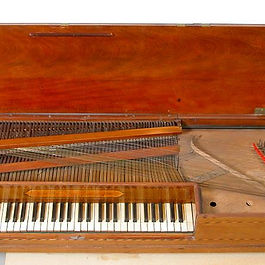
Square Piano/Clavichord by Marr, R
Compass: FF-f3
The action was discarded when the piano was converted to a clavichord
The case is made of mahogany, sides and back 19 mm thick, back corners dovetailed. The case and keywell have ebony and satinwood stringing. There is one molding around the bottom of the case. The right side of the keywell has a semi-circulat cutaway to accommodate the lowest bass strings. There is a tool compartment left of the keywell. The tuning pins are in the back of the case, arranged in six rows of four, then in pairs. They are rectangular and pierced. The wrestplank is veneered in five panels of maple, and has letters indicating note names. The veneer was heavily varnished and does not look original. The soundboard is cantilevered over the top two notes. The grain runs from left to right. The one-piece bridge is beveled, single pinned throughout, and undercut in the bass. There is one visible rib, right of the birdge and running roughly parallel to it. On the right side of the keywell there is an extendable vertical brass rod with a vertical brass disc pinned to it. Its apparent function is to support the front right flap of the lid. The instrument sits on a mahogany trestle stand.