List of Keyboards
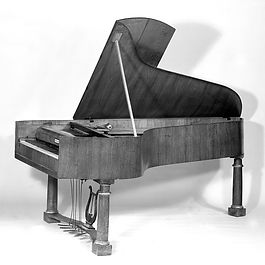
Grand Piano by Lautterer, F
This grand piano was made by Franz Lauterer in Vienna, Austria in the 1820s. Only two of his pianos, both Empire style grands from the 1820s, are known to be extant, one at the Smithsonian and the other at the Bachaus in Eisenach, Germany. This piano has a compass of FF-g4, Viennese action, without back checks, leather hammers, brass and iron strings, triple-strung, 5 pedals: bassoon, moderator, Janissary bell, dampers, and Janissary drum (stops missing), wood frame with two iron tension bars (not original), straight-strung, and a walnut (?) veneer case in the Empire style with a rounded cheek
Credit: Smithsonian


Square Piano by Langenscheid, D
After Brussels, Ghent stood out as the second most important city of piano building in Belgium. Langenscheid produced instruments in 1835 and 1836 from which two instruments remain to proof his skills. Despite all of this he went through a difficult period because the ‘Gazette van Ghent’ informs us of his suicide on December 17 1836. After his death his widow held a public sale of his workshop with 6 finished instruments. The exhibited instrument is in complete original condition and was part of the household effects of the family Mahy from Ghent, famous for their collection of antique cars.
Technical data:
Inscription: D. LANGENSCHEIDT Facteur de Pianos GAND Quai aux Récolletes N° 10
Compass: 6 octaves (FF-f'''')
Keyboard: naturals in ivory, sharps in ebony
Pedals: 3 : celeste - split dampers
Dimensions: W 171 cm / D 73 cm
Case: speckled mahogany
Literature: VANDERVELLEN, P. "Le pianoforte dans les provinces belges (1761-1851)"
Chris Maene Collection number: CM 66 203
Location: 1 - Museum "Piano's Maene" Brussels


Giraffe Piano by Lang, C
Technical description: Case of mahogany veneer, the harp-like upper portion bordered with mother-of-pearl inlay surrounding a pleated silk panel covering the strings, the inlays mainly in the form of 4-point stars; keybed supported at both ends by carved gilt mermaids; the panel enclosing the front of the case below the keyboard having a recessed figured-veneer rectangle with a smaller inlaid oval panel centered above the pedals; compass FF-g4 (75 keys), mother-of-pearl naturals, dark-stained accidental blocks covered with ebony slips inlaid with mother-of-pearl; originally 6 pedals, of which 2 remain: left (once 3rd from left) raising dampers, right (once 3rd from right) of undetermined function; German hägende action with backcheck retained by spring; triple-strung throughout; no wound strings; pinblock veneered with fiddleback maple; unpierced tuning pins. Credit (L. Libin 8 Nov 76)


Square Piano by Kuhn, A
This square piano was made for Anthony Kuhn in Baltimore, Maryland about 1848. It may have been made in Germany for the Kuhn label. More likely, because it has an action patented in Baltimore by John J. Wise, it might have been manufactured by Wise for Kuhn to sell. This piano has a compass of FF-f4, Wise square action, leather hammers, double-strings throughout, tuning pins at the front, 2 pedals: moderator and damper, wood frame, and a wood case.
Credit: Smithsonian

Harp Piano by Kuhn & Ridgeway
This piano was sold by Kuhn & Ridgeway in Baltimore, Maryland and was made in the 1850s. The piano is a “harp-piano,” whose case comes only slightly above the keyboard level revealing the strings and frame. This piano has a compass of CC-c5, standard upright action, felt (?) hammers, single- and double-strings, 2 pedals: keyboard shift and dampers, an iron string-plate top frame, straight-strung, and a gilded and decorated rosewood veneer case
Credit: Smithsonian

Harp Piano by Kuhn & Ridgeway
This upright piano made in the 1850s, was sold by Kuhn & Ridgeway in Baltimore, Maryland. It is a “harp-piano,” a type of upright grand piano in which the strings and framework protrude above the case This piano has a compass of CC-c5, standard upright, felt hammers, single- and double-strings, 2 pedals: keyboard shift and dampers, iron string-plate frame to level keys, straight-strung, and a gilded and decorated rosewood veneer case
Credit: Smithsonian
