List of Keyboards

Upright Piano by Kohnle, J
This upright piano was made by Joseph Kohnle in New York, New York about 1858. Kohnle was a pianist and piano maker in New York during the mid to late 19th century. Little is known about him except that he patented his own piano action in 1860, U.S. Patent 26,909. The patent claims to improve repetition and purports to be applicable to all models of pianos. This piano has a compass of CC-c5, Kohnle patent action, leather hammers, single-, double-, and triple-strings, 2 pedals: dampers operated by a tracker mechanism, cast iron frame, behind the soundboard, and a walnut veneered case
Credit: Smithsonian

Giraffe Piano by Koennicke, J
Technical description: Walnut veneer case curving upward left side and terminating in a scroll with carved wood ornament, the front panels above and below keyboard covered with light yellow silk; 3 piece hinged keyboard cover holding music rack; 2 turned column legs; compass FF-f4 (73 keys), ivory naturals with bone fronts, accidentals of blackened and varnished hardwood; German Hangende action with escapement, hammers mounted in brass kapsels with spring return, damper arms attached to battens and pivoted in metal kapsels, retained by springs; square pierced tuning pins; 29 top notes double-strung, 44 triple strung (currently highest 25 double, remaining 48 single), 6 strings wound (not original); bridge back-pinned; 2 wood pedals, the right raising dampers the left shifting action for una corda; brass lock with decorative front; rectangular nameplate with glass cover and stamped brass frame. Credit: Met Museum

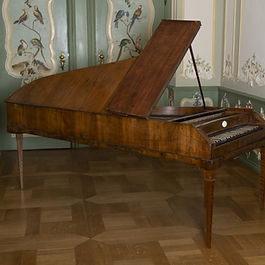
Grand Piano by Koennicke, J
Johann Jacob Könnicke (sometimes spelled König) was a highly respected 18th-century Austrian musical instrument maker based in Vienna. He is widely recognized for crafting organs, clavichords, and historical fortepianos, heavily contributing to the keyboard developments of the Classical period
Photo Credit: Аимаина хикари Wikicommons

Harmony Piano by Koennicke, J
This unique instrument (built in Vienna in 1796) features no fewer than 31 notes per octave, enabling 'pure-third tuning' in all keys. Both Joseph Haydn and Ludwig van Beethoven are said to have played this specific type of instrument
Credit: Wikicommons Andreas Praefcke


Square Piano by Knabe & Company
Compass: AAA-a4 (7 octaves).
Two pedals: moderator, dampers.
Case veneered in rosewood.
Large square piano; compass AAA to a4 (85 keys; 7 octaves). Normal English square-piano action, but with checks and with hammers and levers turning on axle pins. Two pedals: moderator and dampers. Case veneered in rosewood (not Italian briarwood as reported in the legend retold by the donor in the e-mail correspondence copied below). Cast-iron plate painted black with details in gilt (or gold color) and painted flowers.