List of Keyboards


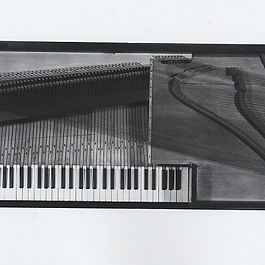
Square Piano by Kearsing, J
This square piano was made by John Kearsing & Sons in New York, New York about 1808. Kearsing and several sons came to New York from London around 1804 and established the firm that same year. The partnership lasted until 1809, when it became John Kearsing & Son until 1816. This piano has a compass of FF-c4, and English double action, leather or felt with leather cover hammers, double-strings throughout, first 10 notes are wound, tuning pins on the right, 1 pedal: dampers, wood frame, and a mahogany case
Credit: Smithsonian

Grand Piano by Katholnick, C
This piano was purchased from Manfred, Count von Schönborn, whose signed affidavit states that the piano had been part of the entailed estate of his wife's family, the Esterhazys, and that it had been among the furnishings at the Esterhazy palace at Eisenstadt. It was, therefore, almost certainly played by the composer and pianist Johann Nepomuk Hummel, who as a child prodigy had been a pupil of Mozart and of Clementi, and later was Haydn's successor to the position of Kapellmeister to the Esterhazys, serving in that capacity from 1804-1811.
This piano may have been at the Esterhazy palace at Eisenstadt when Beethoven was there to conduct a concert in 1807
https://www.youtube.com/watch?v=3RAkKb5HI_c&list=PLy8ZuBE1RYHFM-Nl-04vE-An8Rk7mfo5t


Virginal (Polygonal) by Karest, I
The virginal by Ioes Karest holds a special place in the history of keyboard instruments. Dated 1548, it is the oldest known Flemish virginal and one of the very few surviving examples of the polygonal form. Although only a handful of such instruments have survived, their popularity in the mid-sixteenth century is documented in contemporary paintings, including self-portraits by Catharina van Hemessen and family portraits by Frans Floris and Cornelis de Zeeuw, in which similar instruments are prominently depicted.
The maker's signature, Ioes Karest, appears on the nameboard above the keyboard. Karest was born in Cologne, probably shortly before 1500, and is recorded as a citizen of Antwerp by 1517. His work belongs to the formative period of Flemish keyboard instrument making, several decades before the emergence of the celebrated Ruckers dynasty that would later establish Antwerp as one of Europe's leading centres of harpsichord production.
Photo Credit: Quine, Wikicommons


