List of Keyboards

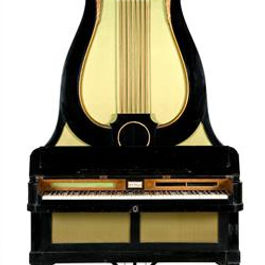


Upright Piano by Heintzman
The prominent Toronto, Canada firm of Heintzman & Co was one of a few that made pianos with transposing keyboards. The most famous user of a transposing keyboard was Irving Berlin, who learned to play by ear, and favored the black keys, playing mostly in F sharp major. Making an action that allows for transposition is challenging, as the keys need to move under the action. The gaps caused by plate struts need to be evened out, and Heintzmann did this by using metal “stickers” descending from the wippens, which were bent to produce an even spacing of all notes. On the positive side, the keys could all be perfectly straight.
Credit: Piano Technician's Guild


Upright Piano by Hecke, van
Inscription: 1er prix/exposition Nationale 1841/VAN HECKE/A BRUXELLES
Compass: 6,5 octaves (CC-g'''')
Keyboard: naturals in ivory, sharps in ebony
Pedals: 2: moderator - damping
Dimensions: W 131 cm / D 60 cm / H 117 cm
Case: ebony polished decorated with ornaments
Serial number: 291
Literature: P. VANDERVELLEN, "The Golden Age of Flemish Harpsichord Making - a Study of the MIM's Ruckers Instruments", 2017
Chris Maene Collection number: CM 64 239
Condition: original
Location: 4 - Museum storage space Ruiselede

Spinet by Hayward, C
While nearly 150 18th-century English spinets have survived, 17th-century examples are less common. The spinets of Haward and his contemporaries are all rather small, with short strings intended to be tuned to the prevailing English "quire"pitch, about one and a half semitones above modern pitch.
The most notable characteristic of Haward's style, immediately evident in this instrument, is the S-shaped bend side. This feature, present in all of Haward's instruments including a harpsichord made in 1683 and in a few instruments by other English makers, gradually passed out of use in England in the early eighteenth century.
Early English keyboard instruments typically are handsome pieces of furniture. The 1689 Haward is no exception, and the curly figure of its walnut case is especially attractive. The interior is veneered in red cedar (imported from the British colony of Bermuda or Virginia). The instrument rests on a stand, certainly old and perhaps of the period, in appropriate 17th-century style with twist-turned legs.
Compass: 4+ octaves, apparently BB to c3, but in a common short-octave arrangement the BB key was tuned to GG, C# to AA, and Eb to BBb or BB. The missing accidentals in the bass, especially GG# and C#, were not often needed in the music of the period. In this spinet, Haward divided the Eb key: the front half plays Eb, the back half BBb or BB. Solid ivory accidentals.