The Butterfly Piano

Can a piano be a work of sculpture?
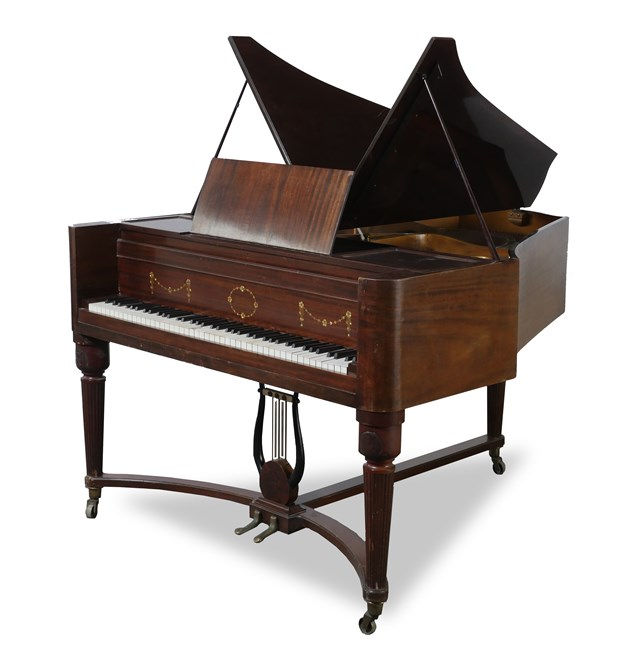
The answer is a resounding yes in this extraordinary grand piano by the Danish maker Soren Jensen, built in Copenhagen around 1930. While every grand piano is designed to be heard, this remarkable instrument was also designed to be admired. Its elegant case, shimmering mother-of-pearl inlay and ingenious lid transform it into one of the most visually striking pianos of the twentieth century.
When opened, the lid spreads into the graceful outline of a butterfly, giving the instrument its affectionate nickname: the Butterfly Grand.
A Piano Unlike Any Other
At first glance, the piano appears unusually compact. Measuring just 160 cm in length, it is smaller than a concert grand yet possesses all the elegance expected of a fine domestic instrument.
The transformation occurs when the lid is raised.
Instead of the familiar single wing found on most grand pianos, Jensen designed the case so that the opened lid creates the unmistakable silhouette of a butterfly with outstretched wings. The effect is both dramatic and surprisingly delicate, turning an everyday musical instrument into a sculptural centrepiece.
Few pianos have been designed with such a close relationship between form and symbolism.
Art Deco Elegance
The Butterfly Grand belongs to the age of Art Deco, a period during the 1920s and 1930s when designers embraced flowing lines, luxurious materials and elegant craftsmanship.
Its beautifully figured mahogany case is enriched with delicate mother-of-pearl inlay, adding flashes of iridescent light that change as the viewer moves around the instrument. These decorative details elevate the piano beyond functional furniture, placing it firmly within the decorative arts of the early twentieth century.
The butterfly itself was a popular Art Deco motif, symbolising beauty, transformation and lightness. Jensen cleverly incorporated this symbolism into the very structure of the instrument.
Music Meets Design
The early twentieth century saw growing interest in what became known as the art-case piano.
Rather than treating the piano as a standard piece of furniture, designers collaborated with cabinet makers and artists to create instruments that reflected contemporary artistic movements. Some were inspired by Art Nouveau, others by Modernism or Art Deco.
Soren Jensen belonged to this tradition. He became known for producing unusual and imaginative piano designs, demonstrating that the external appearance of an instrument could be just as inventive as its musical mechanism.
The Butterfly Grand is perhaps his most memorable creation.
Danish Craftsmanship
Although Denmark has never produced pianos in the same quantities as Germany, Britain or France, Danish craftsmen developed an excellent reputation for fine cabinet making and furniture design.
This piano reflects that heritage. Every curve of the case has been carefully considered, while the quality of the mahogany and the precision of the inlay reveal the skills of highly accomplished craftsmen.
Inside, however, the instrument remains a serious musical piano, with:
a compass of seven octaves (AAA–a'''');
ivory naturals and ebony sharps;
two pedals controlling the keyboard shift and dampers.
Its artistic appearance never compromises its musical purpose.
The Piano as a Centrepiece
During the nineteenth century, the piano was often described as the heart of the drawing room. By the 1930s it had become something more: a statement of modern taste.
The Butterfly Grand was intended to attract attention even before a single note was played. Standing in a fashionable home, it would have served not only as a musical instrument but also as a conversation piece, reflecting the owner's appreciation of both music and contemporary design.
It perfectly illustrates the belief that beauty and functionality need not be separated.
A Rare Survivor
Few art-case pianos survive in their original condition, making the Butterfly Grand in the Chris Maene Collection particularly significant.
Its originality allows us to appreciate the instrument exactly as Soren Jensen intended nearly a century ago. More than simply an unusual piano, it represents a period when designers sought to transform everyday objects into works of art.
The Butterfly Grand reminds us that the history of the piano is about far more than strings, hammers and keyboards. It is also a history of creativity, craftsmanship and imagination.
Like the butterfly that inspired its design, this remarkable instrument combines elegance with transformation. Closed, it is a beautifully crafted grand piano. Opened, it becomes something altogether more magical—a celebration of music taking flight.


Comments