List of Keyboards


Grand Piano by Broadwood, J
The cast iron frame, invented in America a few years before this piano was made, was not immediately accepted by British and Continental makers. A few, however, like Broadwood and Erard, bolted metal bars to the frame to improve tuning stability. The piano has three iron reinforcement bars bolted from pinblock to the bent side of the case as well as metal reinforcement below the soundboard. Credit:Met Museum
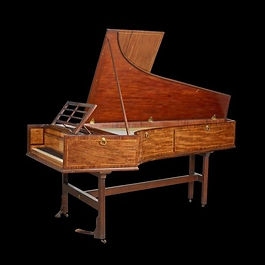
Grand Piano by Broadwood, J & Sons
This piano has a compass of F1 to c4, 68 notes and is triple-stringing throughout. It has two pedals, one raising the dampers and the other an 'una corda'. The outside of the case has mahogany veneer in framed panels with maple stringing. The keywell is decorated with strongly figured satinwood veneer surrounded with ebony and holly stringing. It has an English Grand action, as may be seen in the action model displayed nearby. A hopper or escapement lever is attached to the keylever, and acts directly on the hammer butt. As the key rises the hopper accelerates the hammer toward the string until a point is reached where the changing geometry of the hammer and hopper enables the hopper to escape over a step in the hammer butt. Regulation, so that the escapement occurs just as the hammer is on the point of striking the strings, is accomplished by means of a screw and a leather-covered wooden button. To avoid it bouncing up against the strings again, the hammer is caught in the check, a piece of leather attached to a wire fixed to the tail of the keylever. As the keylever rises it also raises the damper, which consists of a small slip of pearwood guided in a set of upper and lower guides, like the jacks in a harpsichord, with three layers of woollen cloth at their tops. The dampers are prevented from rising too far out of their slots by a mahogany damper rail lined underneath with woollen cloth like a harpsichord jackrail. A dogleg at the bottom of the dampers can be engaged by a lever to raise all the dampers using the pedal. The hammer heads are covered with several layers of leather.
Credit: Royal College of Music


Upright Piano by Broadwood, J & Sons
Compass AA to a4 (6 5/6 octaves; 82 notes); two pedals, moderator (left) and dampers (right). Case veneered in Macassar ebony with a prominent figure. Many edges decorated with gold-colored (gilt?) cast-metal moldings of rope, egg-and-dart, and leaf patterns. Facets of the octagonal legs with gold-colored cast-metal ornaments. In the top section of the front is a removable panel with a gold-colored cast-metal lattice backed by pink silk. On the attached horizontal board below this are two pivoted sconces. A panel similar to the above with lattice and silk covers the front below the keyboard. The back is covered by a panel backed by yellow silk damask.


Square Piano by Broadwood, J
This square piano was made by John Broadwood & Son in London, England around 1810. Originally a cabinetmaker, Broadwood went to work for harpsichord maker Burkat Shudi in 1761, and later became a partner in the firm. Around 1793, the Broadwood and Shudi harpsichord company made its last harpsichord, and a year later changed its name to John Broadwood & Son. This piano is serial number 715A and has a compass of FF-c4, an English double action, leather hammers, double-strings throughout, 1 pedal: dampers, wood frame, and a mahogany case
Credit: Smithsonian