List of Keyboards


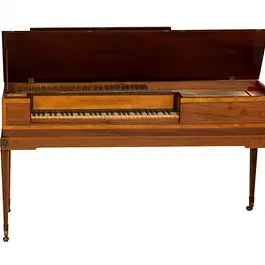
Square Piano by Broadwood, J
The case is made of mahogany with ebony stringing, sides 20 mm thick, veneered back 33 mm thick. A mahogany molding surrounds the base. The nameboard veneered in rosewood with fruitwood stringing. It has three cut out windows. The center on contains the signature which is engraved on tile in ornate script; the outer two contain a decorative wooden plate of dark rosewood with red leather backing. The nameboard is curved and partially covers the extreme treble and bass keys. It has a second music rack screwed to it on the back for use when the lid is raised. The case has four elaborately turned legs with castors, and one turned pedal support on the left side. There is a dust cover, fretwork music rack, and a tool compartment left of the keyboard. The dust cover is 6 mm thick and is painted green with a white pinstripe 19 mm in from the edge. The rectangular tuning pins are pierced and are located on the left and back sides of the instrument, with letters indicating notes
This is a stock photo and does not represent the instrument

Grand Piano by Broadwood & Sons
John Broadwood & Sons was the most imported piano manufacturer of the late 18th and 19th centuries in England. He had a strong reputation far beyond its borders. He was in contact with all the eminent musicians who came to London. Haydn, Clementi, Handel and contemporaries. His instruments were very innovative, with 3 string for each note, split bridges for the bass strings, metal bracings, pedals for shifting keyboard (duo or una corda) and split damping. This Broadwood is almost identical to Beethovens grand of 1817.
Technical data:
Inscription: John Broadwood & Sons Makers to His Majesty é The Princesses Great Pulteney street, Golden Square London
Compass: 6 octaves (CC-c'''')
Keyboard: naturals in ivory, sharps in ebony
Pedals: 2: keyboard shift (duo or una corda) - split damper pedal (left bass, right trebble)
Dimensions: L 247 cm / W 114 cm
Serial number: 5557
Chris Maene Collection number: CM 31 205
Condition: restored to concert level, Chris Maene workshop 2023
Location: 3 - Museum headquarters "Piano's Maene" Ruiselede


Grand Piano by Broadwood, J
Technical Description: Case of mahogany and mahogany veneer over oak, sides veneered with mahogany panels, holly wood striping and contrasting crossbanded mahogany borders, lid of solid mahogany with holly striping; nameboard, keyboard end blocks and inner surface of cheeks veneered with curly maple with black and white striping and contrasting mahogany borders; mahogany trestle stand with 4 square legs with casters; brass ring handles, lock cover with scrolled brass hinges; keyboard cover with scrolled keyhole; brass rosette in center of each short stretcher; spruce soundboard; oak pinblock veneered with curly maple; compass FF-f3 (61 keys); ivory naturals with molded keyfronts, ebony accidentals, 2 wood pedals pivoted to front legs, left pedal shifting action to the right (striking 1 or 2 strings), right pedal raising dampers; English grand action, single escapement regulated by oblong-head screws accessible behind nameboard, with backcheck, no intermediate lever; damper jacks fitting through mortised registers; leather covered hammers; triple-strung throughout, no wound strings, lowest 14 notes strung in brass; oblong, pierced tuning pins; split bridge dividing at G#-A; 3 metal gap-spacers; with music rack (b), felt-lined damper rail (c), stick to support cover (d), keyboard front cover (e). Credit (L. Libin 1976)